The position
What is happening, what matters now, and what may be getting in the way.
 The Deal Maker OSSee Command Solo
A platform from BizForge Hub
The Deal Maker OS is a decision and execution platform that connects multiple systems within one structured operating environment. It is designed for real estate operators working through active decisions, execution pressure, and work that must remain visible, organized, and reviewable.
Command Solo is our primary system for individual real estate operators: available now, under continued development, and the focus of current external validation.
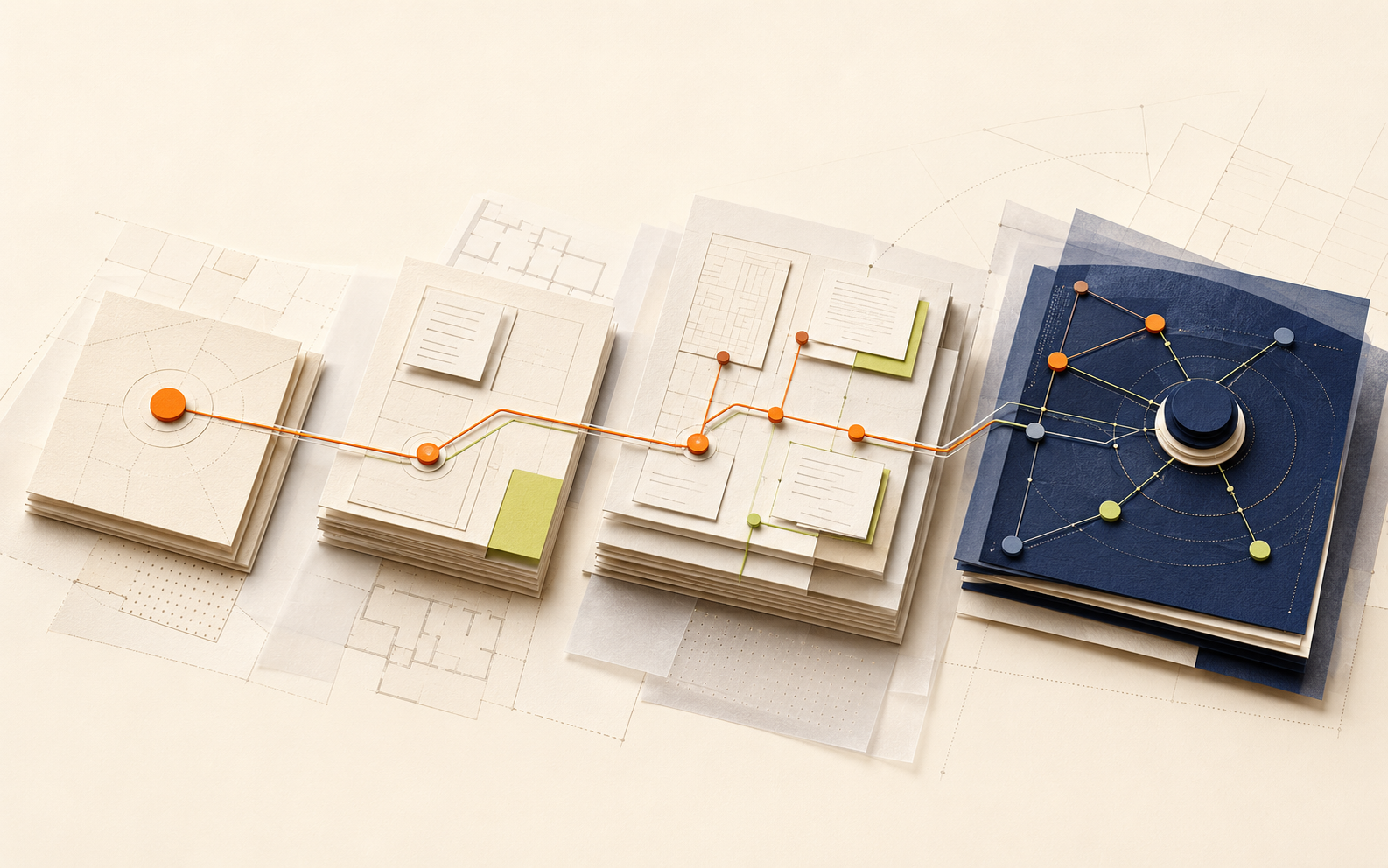
THE STRUCTURE
What is happening, what matters now, and what may be getting in the way.
The principle, the present constraints, and the action being contemplated.
A defined structure that can be revisited as the operation changes.
PRIMARY PRODUCT · AVAILABLE · CURRENT VALIDATION FOCUS
Operating intelligence for an individual real estate operator.
Active real estate work changes after the original decision is made. New evidence arrives. Assumptions change. Commitments move. Tasks get completed. Information gets scattered across records and conversations.
What can disappear is the reason you made the decision in the first place. Command Solo is designed to help preserve the operating picture as those conditions change.
Distinguish evidence from assumptions and unknowns. Identify what actually deserves attention under present constraints.
Pressure-test material decisions, connect new evidence to prior reasoning, and determine the smallest justified next move.
Preserve Decision Continuity and carry approved decisions into controlled execution through supported tools, with verification of consequential actions after they occur.
PRESERVE THE REASONING
A completed task does not always preserve why the task mattered.
Command Solo is designed to preserve:
This allows you to return to a decision later without rebuilding the reasoning from memory.
HOW COMMAND SOLO WORKS IN PRACTICE
Illustrative operating example, not a customer result.
“I’m not making an offer until the contractor’s repair estimate comes back.”
Solo recognizes that this appears to be a material operating decision, reflects it back, and asks whether you want it preserved. You confirm.
Solo preserves the decision, the reason for it, what remains unknown, and what should cause reconsideration. Later, you ask: “What was my last decision on this property?” Solo retrieves the preserved decision and supporting context.
When the repair estimate arrives, Solo evaluates the new evidence against the original decision instead of treating the situation like a brand-new problem.
The work can move forward without the reasoning having to start over.
Current priority: external validation in real operating use.
Solo is available while development and validation continue. Execution and verification depend on the connected tools it currently supports and the evidence returned. Availability is not a claim of proven reliability in every operating condition.
PERSPECTIVE
ONE OPERATING ENVIRONMENT
They are not.
Every decision changes the work that follows. Every operating condition carries a different level of pressure and structure.
The Deal Maker OS began with a real estate deal that fell apart at closing. I had approximately $8,000 to $12,000 on the line. The loss mattered, but what stayed with me was how the deal collapsed.
The warning signs had appeared long before closing. I had not properly researched the buyer, how he funded his deals, or whether he had a reliable history of closing. After signing the agreement, he sent someone to the seller's rental property who made direct contact with the seller. The seller became confused and called me, leaving me to repair a situation that should never have developed that way. It was one warning sign among many.
Looking back, I lacked structure mentally, physically, emotionally, and operationally. I was moving the deal forward without a structure capable of helping me investigate the buyer, interpret accumulating risk, and act on what I was seeing before the transaction reached closing.
I cannot say that the right structure would have guaranteed the deal closed. Some deals will still fall apart. But it would not have fallen apart for the reasons it did. The risk was visible. I was not structured enough to interpret it or disciplined enough to respond.
That experience changed how I understood failure in real estate. An opportunity can begin well and still deteriorate when the operator lacks the structure required to carry sound decisions through real conditions. Missed signals accumulate. Poor decisions reinforce one another. Eventually, the result reflects what was left unmanaged.
I did not need another collection of tactics. I needed an operating system.
That recognition became the foundation of BizForge Hub and The Deal Maker OS. I began developing the structure I had needed, then came to see that different operating conditions require different forms of structure. Command Solo centers the individual operator and is the current product and external-validation focus. Command Pro is a future scaling path for growing responsibilities and stronger coordination. OCEAN is the longer-term direction for leadership and governance.
These systems did not arrive as a finished company after one failed deal. They have developed through failure, reflection, testing, and continued observation. They share one foundation: ambition and information are not enough when the operator lacks the structure to carry decisions through changing conditions.
The mission is not to suggest that every deal can be saved. It is to build around the distinction between an unavoidable outcome and a preventable failure that was allowed to keep developing.
OPERATING CONDITIONS
The statements below describe common operating conditions. A selection reveals the system designed around that condition. It is a point of reference, not a diagnosis.
Operating intelligence for one operator
Command Solo helps one real estate operator understand the current operating position, pressure-test decisions, and preserve Decision Continuity as evidence and commitments change. Approved actions can move into the connected workflows it currently supports. The operator remains the authority.
THE LINEUP
Command Solo is the primary product. Command Lite remains available for a lighter level of structure. Pro and OCEAN describe the future architecture, not equally mature products.
Command Solo and Command Lite are available. Solo is the current external-validation focus. Command Pro is incomplete and in development; OCEAN is a future governance layer. Neither future path is offered for purchase here.
Judgment, continuity, accountability, and controlled execution across active real-estate work.
One active direction, decision containment, and a defined execution flow.
Operations change over time.
The appropriate level of structure can change with them.